Penno
LiveAn AI knowledge base for teams that connects tools like Google Drive, Notion, and company files, then grounds AI chat and writing in trusted knowledge with source citations.
Penno in one sentence
Penno is a shared AI workspace that connects a team's existing knowledge, makes it searchable with citations, and carries that context into writing and repeatable agent workflows.
The product idea
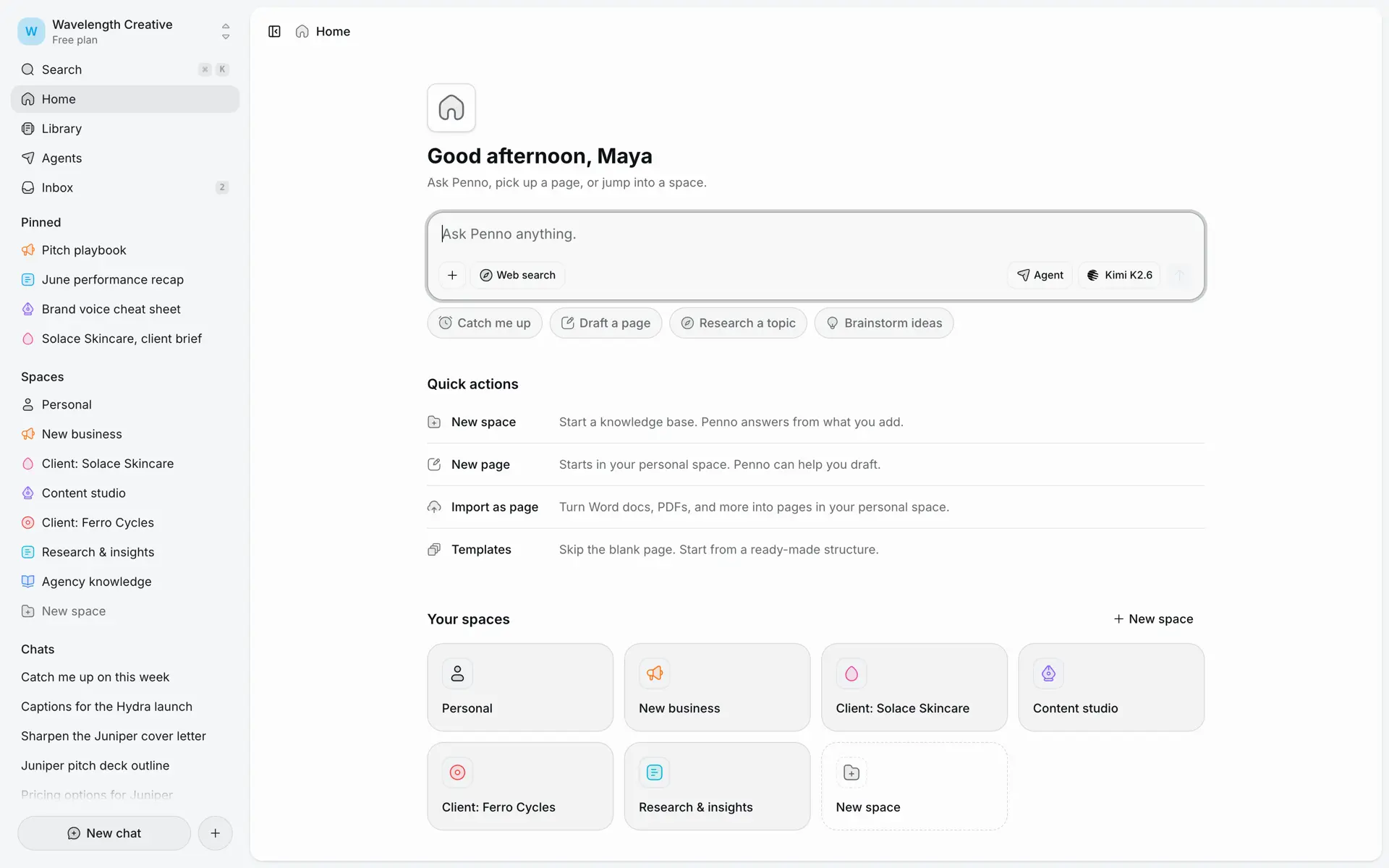
Most teams do not have a knowledge shortage. They have a knowledge-location problem. The useful material is spread across cloud drives, wikis, uploaded files, project pages, and the memories of individual teammates. Generic AI chat adds another destination without necessarily solving that fragmentation.
Penno takes the more useful approach: leave the source material where it already lives, connect it, and make the combined knowledge available inside a working environment. Google Drive, Notion, direct file uploads, and other sources feed spaces where teams can search, chat, write, and organize work.
The important product decision is that retrieval and creation share the same context. A cited answer can become a draft; a draft can live beside its supporting material; an agent can work from the same permission-aware knowledge. Penno is aiming to be the connective layer, rather than another isolated AI assistant.
What stands out
Answers come with receipts
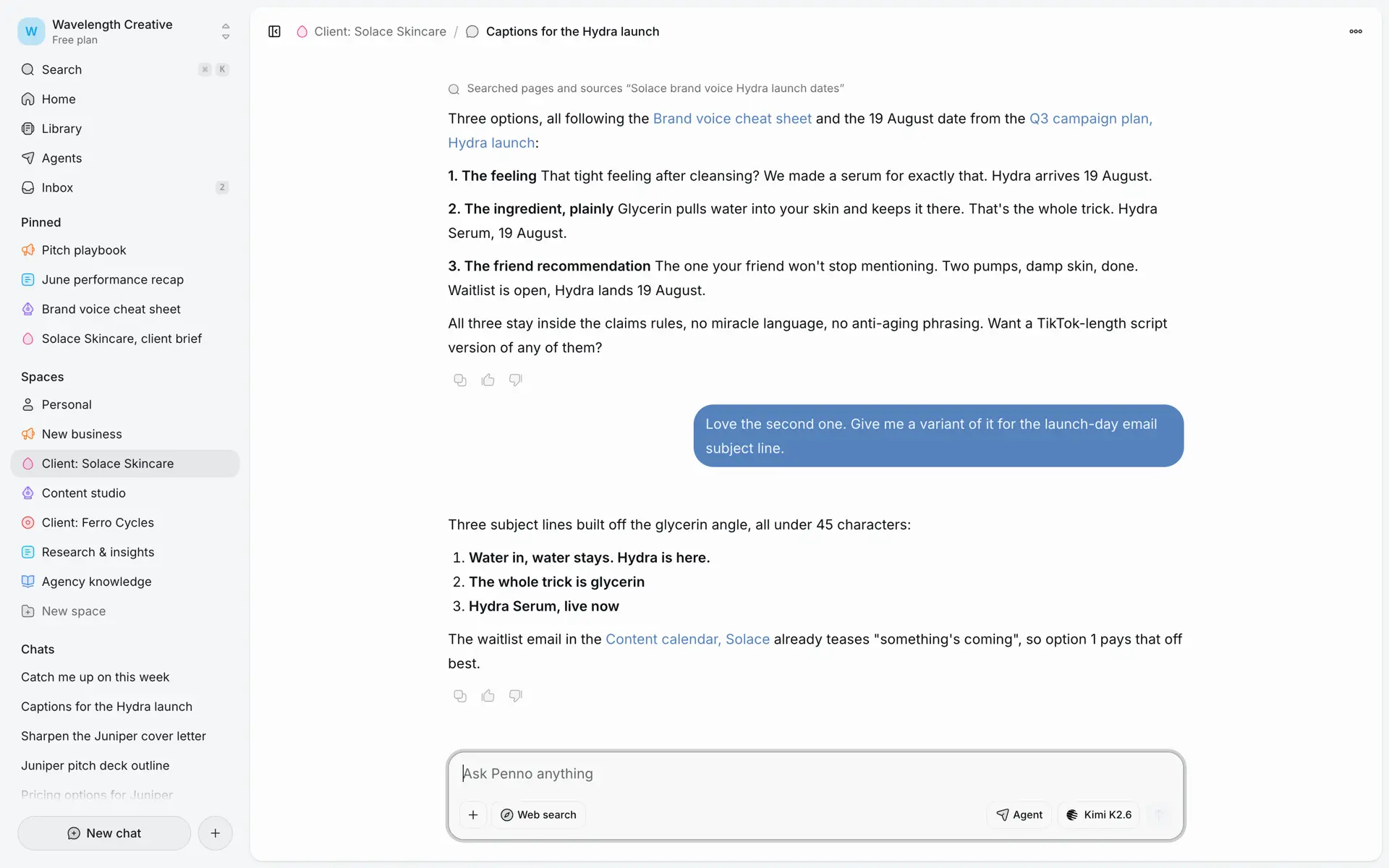
Penno combines semantic and lexical retrieval, then links answers back to the pages and files it used. That citation layer matters. In a team setting, a plausible answer is not enough: people need to verify a number, inspect the original wording, and understand whether the source is current.
The research experience also keeps the conversation connected to a specific space or searches across everything the user can access. This gives teams a practical choice between tightly scoped context and broader discovery.
Spaces create useful boundaries
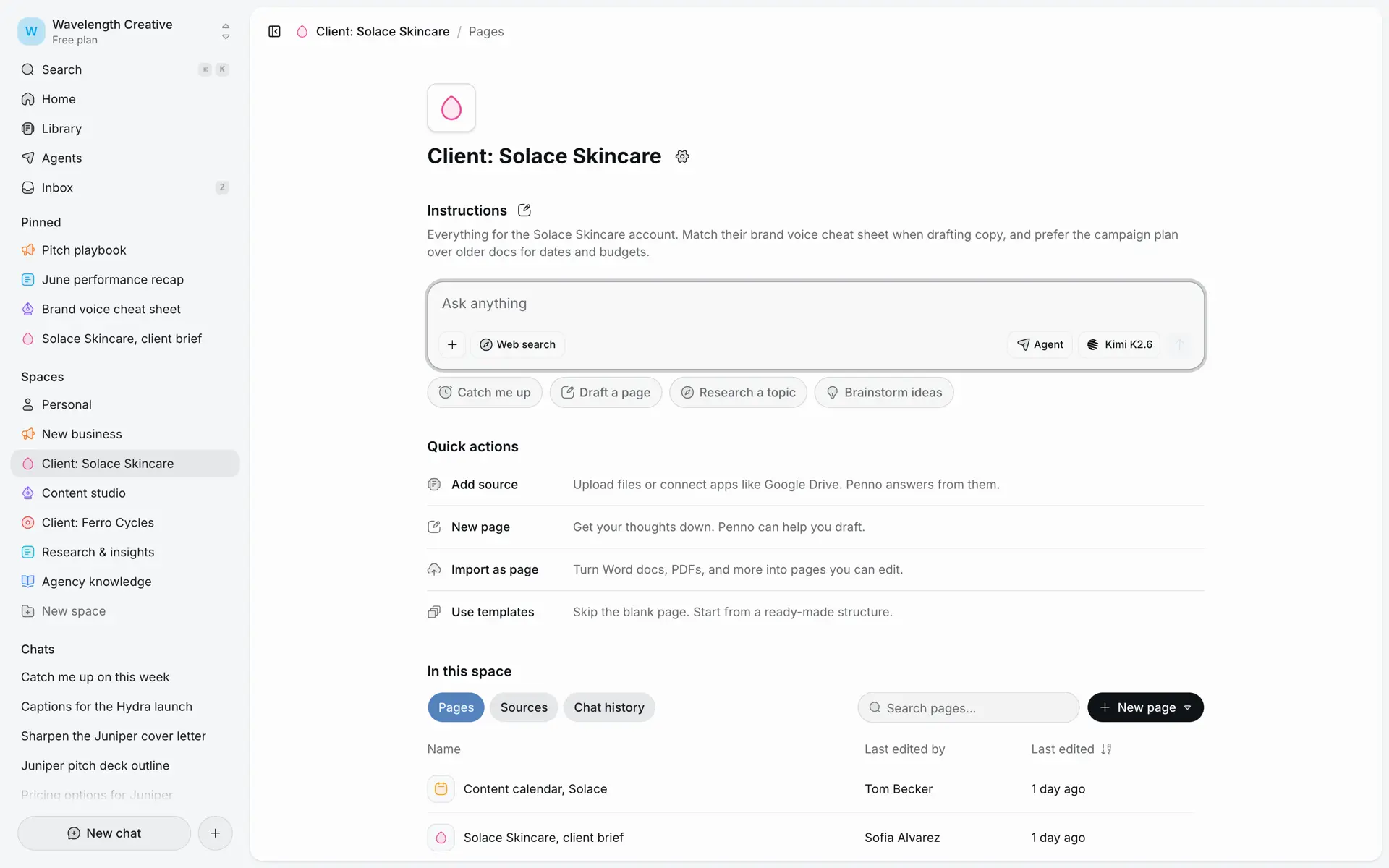
A space groups the pages, imported sources, AI instructions, and conversations for one project, team, client, or topic. This is a stronger organizing model than throwing every document into one undifferentiated knowledge base.
Custom instructions give each space its own working rules—tone, preferred sources, output format, and material to ignore. Public and private spaces, roles, and permission-aware retrieval provide the boundaries needed when the same workspace contains company, team, and client knowledge.
Writing is part of the workflow
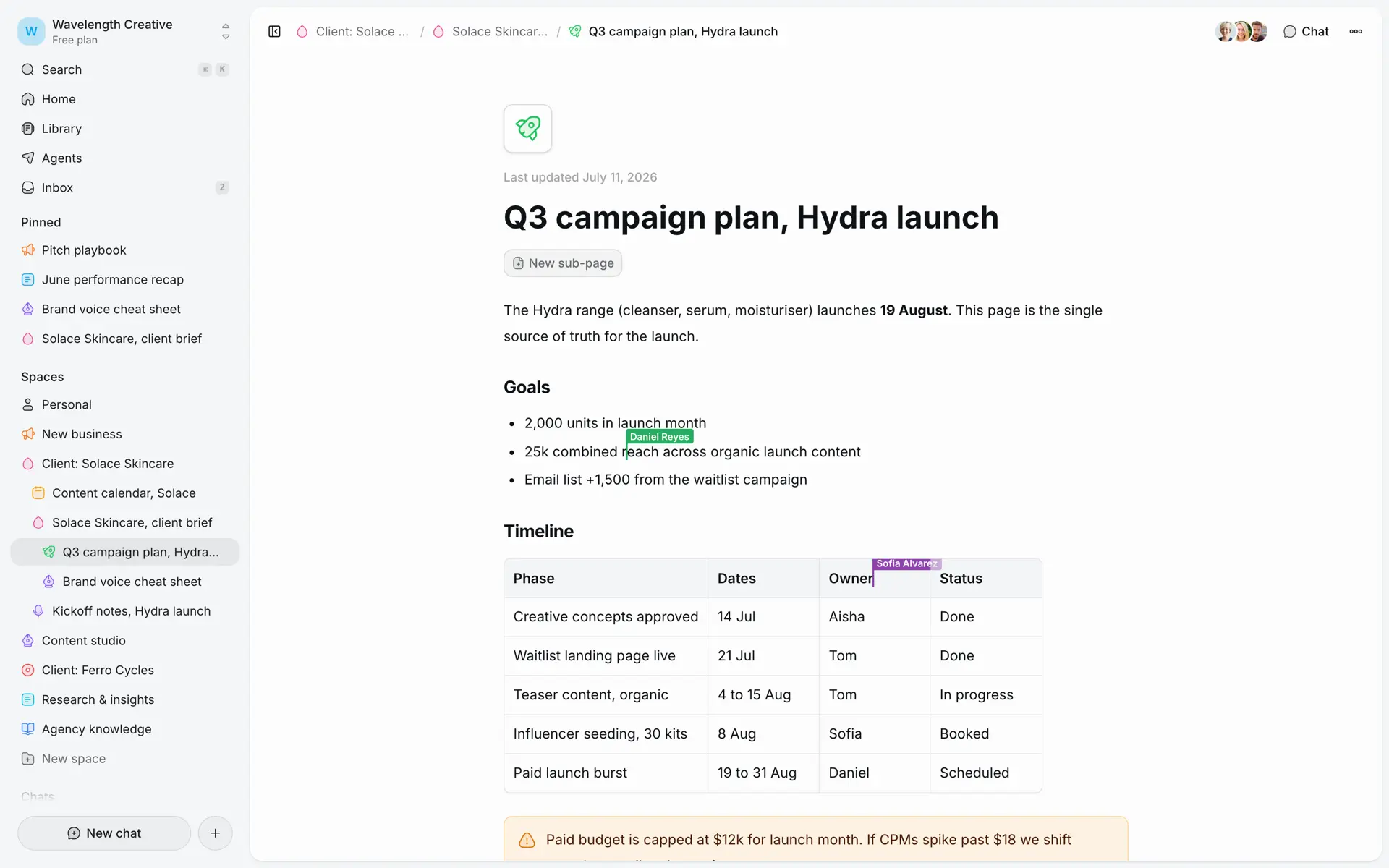
Penno is not only a search box. Its block editor supports hierarchical pages, multiplayer presence, templates, comments, and offline-safe collaboration. The AI can draft or rewrite inside the page using the surrounding workspace as context, with changes presented as suggestions to accept or reject.
This makes the product loop feel coherent: collect knowledge, find evidence, turn it into work, and keep the result in the shared system. The alternative—copying an answer from a chatbot into a separate editor—loses context at exactly the moment it becomes valuable.
Agents are attached to real context
Penno's agents are designed around recurring team jobs such as research, meeting notes, and weekly updates. A team can start with a refined agent or configure its own, point it at selected spaces and files, and keep its access within the permissions of the person using it.
The promise is more compelling than a gallery of generic bots because the agents can draft pages, use sources, leave comments, and involve another agent while operating inside the team's existing knowledge structure.
Product assessment
Penno's strongest quality is the shape of the whole system. Sources, retrieval, writing, collaboration, permissions, templates, model choice, and agents reinforce one another instead of appearing as disconnected AI features.
The interface shown on the landing page is calm and document-first. It exposes AI prominently without letting chat consume the entire product. Spaces and pages remain visible, which makes Penno look like somewhere a team can work—not merely somewhere it can ask questions.
The hard part will be operational trust. Products in this category succeed or fail on connector reliability, indexing freshness, retrieval quality, citation accuracy, and perfect permission enforcement. Those are not weaknesses demonstrated by the marketing page; they are the standard Penno will need to meet as teams entrust it with more of their knowledge.
Who it is for
Penno is best suited to teams whose work depends on repeatedly finding, combining, and rewriting internal knowledge: agencies, product teams, consultancies, research groups, and operations teams are natural fits.
It will be most valuable when documents are already scattered across several tools and the team wants AI assistance without a disruptive migration. A solo user who only needs generic chat may not need the collaborative layer. A team with clients, recurring deliverables, and shared context is much closer to the centre of the product.
Verdict
Penno is building toward a credible answer to a real workplace problem: AI is much more useful when it knows the team's sources, respects their boundaries, and helps produce the next piece of work.
Its most convincing idea is not any single AI feature. It is the continuity from source to answer to draft to shared knowledge. If Penno can make that loop reliable at scale, it has the foundations of a product teams can use every day rather than another assistant they occasionally visit.
Further reading
- Explore the Penno product
- Browse Penno integrations
- Read about security and trust
- Compare plans and pricing
Review based on Penno's public product information and marketing materials, accessed August 2026.